
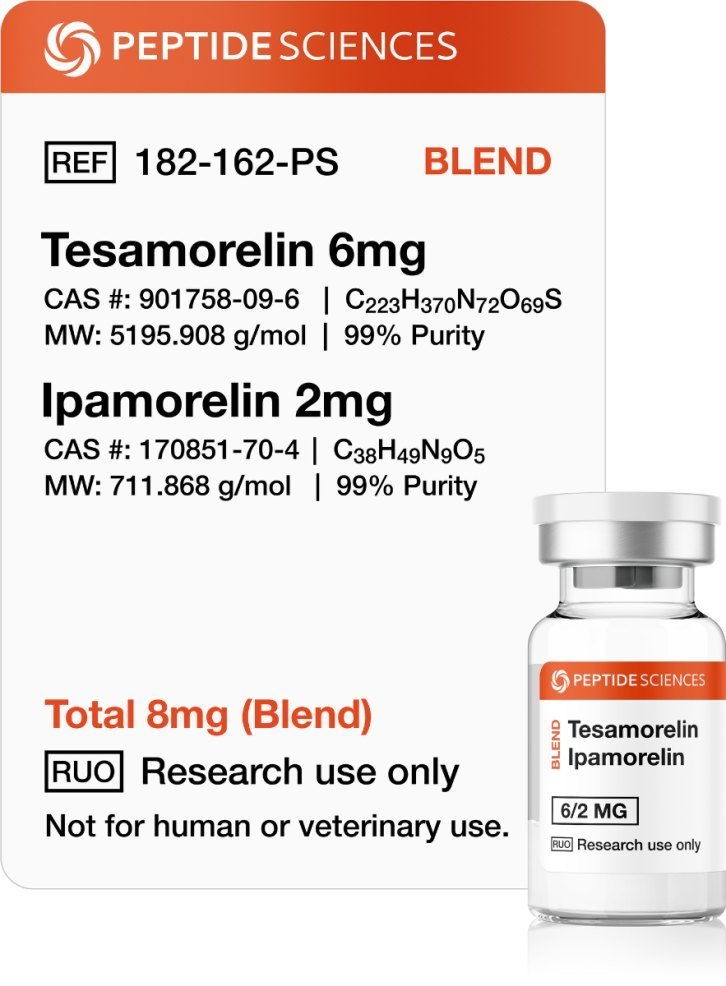
Tesamorelin and Ipamorelin 8MG: Research Overview, Growth Hormone Pathways, and Safety Information
Introduction to Tesamorelin and Ipamorelin Research
Tesamorelin and Ipamorelin are peptide compounds that have attracted scientific interest because of their relationship with growth hormone regulation and endocrine signalling pathways. Both peptides are studied in the field of hormone research due to their interactions with biological systems involved in growth hormone production.
Tesamorelin is a synthetic analogue of growth hormone-releasing hormone (GHRH), while Ipamorelin belongs to a class of compounds known as growth hormone secretagogue peptides. Researchers study these peptides to better understand how the body regulates growth hormone release and related metabolic processes.
This article provides an educational overview of Tesamorelin and Ipamorelin, including their mechanisms, research applications, biological pathways, and important safety considerations.
What Is Tesamorelin?
Tesamorelin is a synthetic peptide designed to mimic the activity of naturally occurring growth hormone-releasing hormone (GHRH).
GHRH is produced by the hypothalamus and plays an important role in communication between the brain and pituitary gland. This pathway regulates the release of growth hormone, which contributes to several biological processes.
Research involving Tesamorelin focuses on:
- Growth hormone signalling
- Endocrine system regulation
- Metabolic pathways
- Hormonal communication
By studying Tesamorelin, researchers gain insights into how GHRH pathways influence physiological functions.
What Is Ipamorelin?
Ipamorelin is a synthetic peptide classified as a growth hormone secretagogue. Unlike Tesamorelin, which works through GHRH pathways, Ipamorelin is studied for its interaction with growth hormone secretagogue receptors.
Researchers investigate Ipamorelin because of its role in understanding:
- Growth hormone release mechanisms
- Peptide-receptor interactions
- Hormonal signalling pathways
- Endocrine regulation
The study of Ipamorelin contributes to broader research into how peptide signals influence hormone production.
How Do Tesamorelin and Ipamorelin Work?
Tesamorelin and Ipamorelin affect growth hormone pathways through different biological mechanisms.
Tesamorelin Mechanism
Tesamorelin interacts with GHRH receptors in the pituitary gland. This stimulates signalling pathways associated with growth hormone production.
The pathway involves:
- Hypothalamus releases GHRH.
- GHRH communicates with the pituitary gland.
- Growth hormone production is regulated.
- Growth hormone influences downstream processes, including IGF-1 activity.
Ipamorelin Mechanism
Ipamorelin is studied for its interaction with growth hormone secretagogue receptors. Researchers examine how this pathway influences growth hormone signalling.
Both peptides provide valuable research models for understanding endocrine communication.
Growth Hormone and IGF-1 Research
Growth hormone plays an important role in several biological processes. One major area of research involves insulin-like growth factor-1 (IGF-1).
IGF-1 is produced primarily in response to growth hormone activity and is studied because of its involvement in:
- Cellular growth processes
- Tissue development
- Metabolic regulation
- Biological signalling
Researchers examine Tesamorelin and Ipamorelin to better understand the relationship between growth hormone pathways and IGF-1 activity.
Scientific Research Areas
Endocrinology Research
Tesamoreln and Ipamorelin contribute to scientific studies exploring how hormones are produced, regulated, and controlled within the body.
Researchers examine:
- Pituitary gland function
- Hormone receptor activity
- Feedback mechanisms
- Endocrine communication
Metabolic Research
Growth hormone pathways are connected with metabolism, making these peptides relevant in metabolic science.
Studies explore how hormone signalling interacts with:
- Energy balance
- Fat metabolism
- Body composition processes
Peptide Biotechnology
Research into peptides supports advances in biotechnology by helping scientists understand molecular communication and receptor interactions.
Differences Between Tesamorelin and Ipamorelin
Although both peptides are connected with growth hormone research, they work through different pathways.
Tesamorelin:
- Related to GHRH activity
- Studied for effects on growth hormone signalling
- Provides insight into hypothalamus-pituitary communication
Ipamorelin:
- Classified as a growth hormone secretagogue
- Studied for receptor-based hormone signalling
- Provides insight into peptide-receptor interactions
Understanding these differences helps researchers evaluate how different peptide structures influence biological systems.
Safety Considerations and Medical Guidance
Hormone-related compounds can influence complex biological pathways. Proper scientific evaluation and professional medical guidance are essential when discussing hormone-modulating therapies.
Healthcare professionals consider factors such as:
- Individual health history
- Existing medical conditions
- Hormone levels
- Possible interactions
- Long-term safety information
The effects of hormone-related compounds can vary depending on individual circumstances.
Regulatory Information in the USA
In the United States, peptide compounds may have different regulatory classifications depending on their intended use, formulation, and approval status.
Prescription medications, research compounds, and experimental substances follow different regulatory pathways.
Individuals should consult qualified healthcare professionals and rely on trusted medical resources for accurate information regarding hormone-related compounds.
What are Tesamorelin and Ipamorelin?
Tesamoreln and Ipamorelin are synthetic peptides studied for their relationship with growth hormone regulation and endocrine pathways.
How are Tesamorelin and Ipamorelin different?
Tesamoreln is associated with GHRH pathways, while Ipamorelin is studied as a growth hormone secretagogue that interacts with specific receptors.
Why are these peptides researched?
Scientists study these compounds to understand growth hormone signalling, hormone regulation, and metabolic processes.
Are peptide compounds the same as approved medicines?
No. Research compounds and approved medications have different regulatory requirements and safety evaluations.
Conclusion
Tesamoreln and Ipamorelin represent important areas of peptide and endocrine research. By studying these compounds, scientists continue expanding knowledge about growth hormone regulation, receptor signalling, and metabolic pathways.
Understanding the science behind these peptides requires careful evaluation of research evidence, regulatory information, and professional medical guidance. Continued investigation into growth hormone-related pathways may provide valuable insights into the complex systems that regulate human biology.

Reviews
There are no reviews yet.